Genomics 101: Dominant, Recessive and Beyond
Learn about how genetic conditions are inherited and how to recognise the common modes of inheritance in a family history, in this short, flexible online course.
- Delivery
- Part time
- Mode of study
- Online
- Time commitment
- 30 minutes
- Reward
- Certificate of completion
Part of a series of courses covering topics such as how DNA is passed from parent to child and how to record a family history, this e-learning has been developed for healthcare professionals with little or no previous genomics knowledge. At the end of each course, there is an opportunity for learners to demonstrate what they have learnt and download a certificate of participation.
To view all the courses in this series, browse through our Genomics 101 collection.
Sign up for free (NHS and UK universities)
Subscribe for paid access (all others)
About the course
This course explores how genetic conditions are inherited. The main purpose of this course is to help you understand the common modes of inheritance of genetic conditions and to be able to identify them based on the pattern of affected people in a family history. The session will also cover how the recurrence risks are calculated for each type of inheritance.
Why take this course?
As the use of genomics in healthcare increases, so does the understanding of how the genetic information we inherit from our parents can affect our health. This course is designed to provide an overview of how genetic conditions are inherited and how this can be used to provide insight into the conditions for family members.
Who is this course aimed at?
This course is primarily targeted at all healthcare professionals working in the NHS who have had limited exposure to genomics in their clinical role.
What will I learn?
The course covers the following topics
- How genetic conditions arise
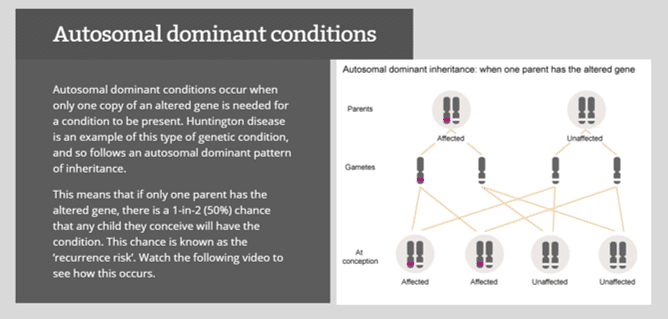
- Autosomal inhertitance
- X-linked inheritance
- Other types of inheritance
- Multifactorial conditions
How will I learn?
The course is delivered through textual content, graphics and animations. There are knowledge checks throughout and, on completion of the course, a final assessment for learners to demonstrate what they have learnt.
Related sessions
If you are unfamiliar with the subjects covered in this course please consider taking these other courses in the Genomics 101 series: