What do I need to know?
Why is genomics important in dermatology?
Although more than 800 skin diseases with genetic causes have now been identified, many patients still do not have a secure genomic diagnosis – and are likely to face quite a journey to reach one.
As skin diagnostic experts, dermatologists are well placed to decide which genomic tests are required for specific patient presentations. To that end, since 2020 dermatologists have had the ability to request testing for certain skin conditions via the National Genomic Test Directory. This means that they also hold responsibility for interpreting and communicating test results for those conditions. In this way, dermatologists can play an important role in counselling families in which one or more members is affected by a genetic skin condition.
Genomic testing can have a significant impact on clinical management and overall patient outcomes. For example, a genomic diagnosis could provide access to skin cancer and internal malignancy screening, meaning that detection happens earlier, leading to an improved prognosis. In addition, an ever-increasing number of targeted therapies are becoming available for various genetic skin diseases – such as dystrophic epidermolysis bullosa – as well as opportunities to enter clinical trials in, for example, PIK3CA overgrowth spectrum conditions.
How is genomics used in dermatology?
Many skin diseases have an underlying genetic cause, and more links are being made all the time between skin presentations and the genome. By thinking about genomics in their day-to-day clinical practice, a dermatologist may be able to reach a precise genomic diagnosis for their patient – which can significantly alter the course of that patient’s treatment and management, and can have a positive impact on their overall health outcomes.
Below are some specific areas of dermatology in which genomics is currently being used for the benefit of patients and their families.
How can I play my part?
Further learning and guidance
The mainstreaming of genomic medicine is a central theme in the NHS Long Term Plan, which means that it is now more important than ever for clinicians working across all medical specialties to develop their understanding of what genomics is and how it applies to their practice.
There is a wealth of training and education resources available, from bitesize genomics resources and short online courses that cover the basics to more in-depth courses about genomic testing within the NHS, and the majority are free for NHS employees.
There are also rare disease collaborative networks that can provide expert advice on conditions that impact the skin, such as tuberous sclerosis complex, mosaic skin diseases and PTEN hamartoma tumour syndrome. The Skin Genetics Group, part of the British Association of Dermatologists, also hosts a meeting at the national annual conference during which genetic skin cases are presented and clinically relevant research updates are provided by leading experts.
If you wish to learn more about a particular genetic skin condition, a good place to start is with its dedicated organisation and/or patient advocacy group, if they exist. Some such groups include:
- the Ichthyosis Support Group;
- the Pachyonychia Congenita Project; and
- DEBRA UK.
Case examples
Familial melanoma
- A male patient aged 35 is referred by the skin cancer MDT because he has developed a melanoma and has a family history of melanoma.
- His older brother has been diagnosed with metastatic melanoma warranting surgery and immunotherapy, and his mother has already had surgery to remove three melanomas, starting from the age of 30.
Figure 2: A pedigree showing the patient’s known family history
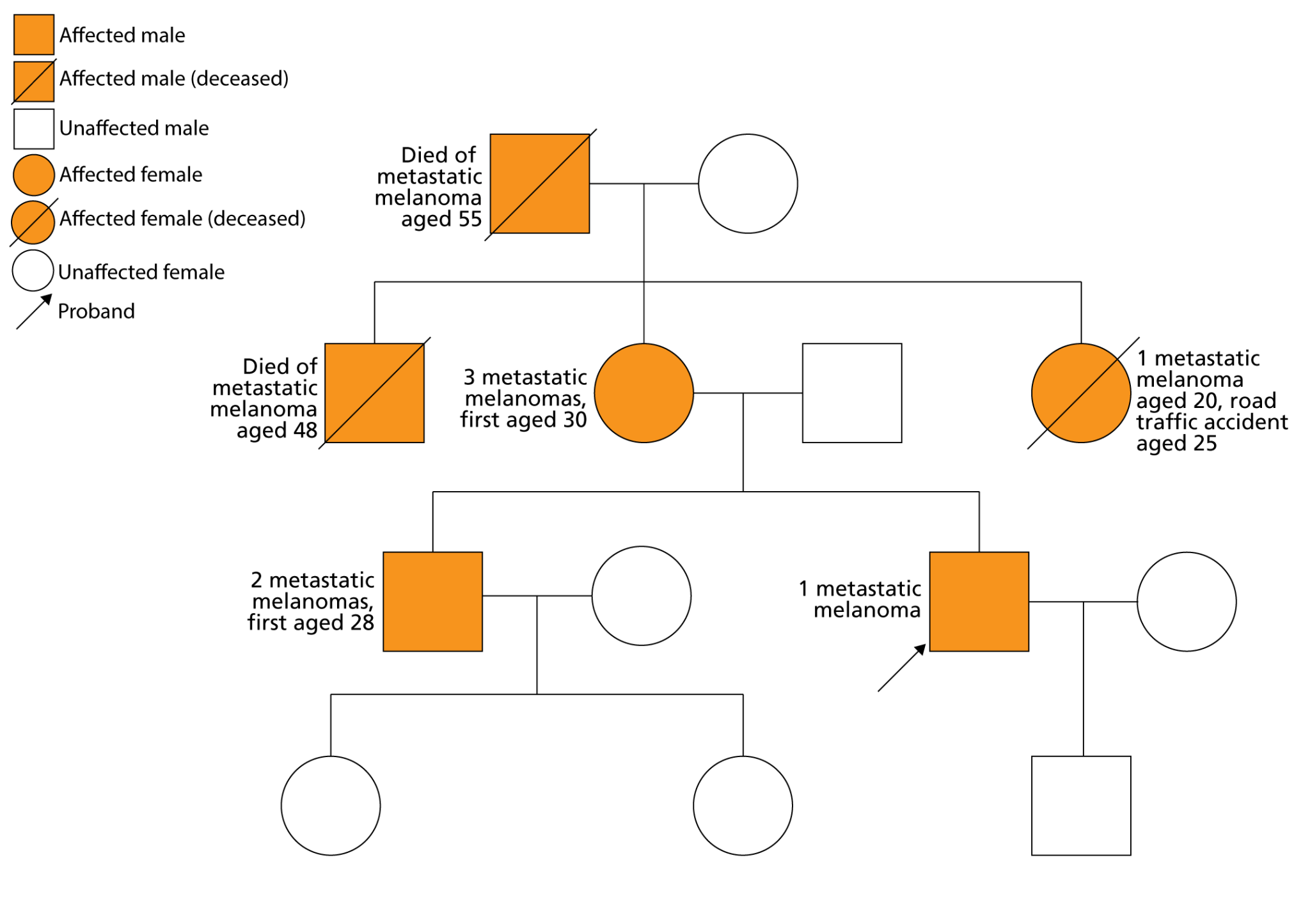
- Suspecting a familial melanoma-predisposing genetic variant, the patient’s dermatologist asks his mother to provide a blood sample for genomic testing.
- Four genes are tested as part of the melanoma gene panel (which sits under the test code R254 in the National Genomic Test Directory), and a variant in CDKN2A is found. As a result, a diagnosis of familial atypical multiple mole melanoma syndrome (FAMMMS) is confirmed. FAMMMS is a condition in which patients can develop multiple atypical moles and melanoma, making it difficult for them to notice changing moles. It is inherited in an autosomal dominant pattern and is known to be associated with carcinomas in other parts of the body, primarily the pancreas.
- The dermatologist refers the case to the local clinical genetics service, and cascade testing is carried out by genetic counsellors. Various family members are also found to have the CDKN2A variant. All those affected are offered skin surveillance and, from the age of 40, endoscopic ultrasound to screen for pancreatic cancer. Those found to be unaffected are advised about sun protection and self-surveillance to monitor any changes in the skin.
- In this case, genomic testing helped identify high-risk individuals within the family, influenced lifestyle choices and raised awareness of the importance of self-examination and early reporting.
Last updated on 10th September 2025